Governance
Governance records source rights, privacy, retention, reviewer decisions and provenance.
Release basis
Loading in simulation does not make an asset releasable. Source rights may be unclear, a physical value may apply only to a narrow task and provider output may need redaction. Governance records those conditions for later release decisions.
How to make a release decision
Agent skill: governance-provenance-lead. Tools: governance_record, governance_project_create, governance_external_model_run and governance_mutation_validate. The orchestrator generally leaves governance until the end, then gathers source, provider, validation and review records for the release decision.
Technical claims originate in source, provider, validation and review records. Governance cites those records when deciding release state.
Before release, confirm:
- source rights allow the intended use
- provider traces are redacted
- validation reports match the claimed promotion state
- review-required claims have reviewer decisions
- the record graph and task-fitness gate pass for the declared release scope
- blocked reasons are empty
Required records
- run request
- project manifest
- source rights record
- provider trace with secrets redacted
- validation report
- reviewer decision
- exact run, request, asset fingerprint and Profile binding
- decision expiry and immutable decision history
- task-fitness evidence for the declared release scope
- checksum record
- promotion state
Process
- Read the source, provider and validation records for the project.
- Confirm release rights, retention policy and redaction state.
- Record reviewer decisions for weak or task-critical claims.
- Attach blocked reasons when promotion is not allowed.
- Generate the decision from current project state with
afb governance decide. - Inspect the preview, then repeat with
--writeto create the current pointer and immutable history record.
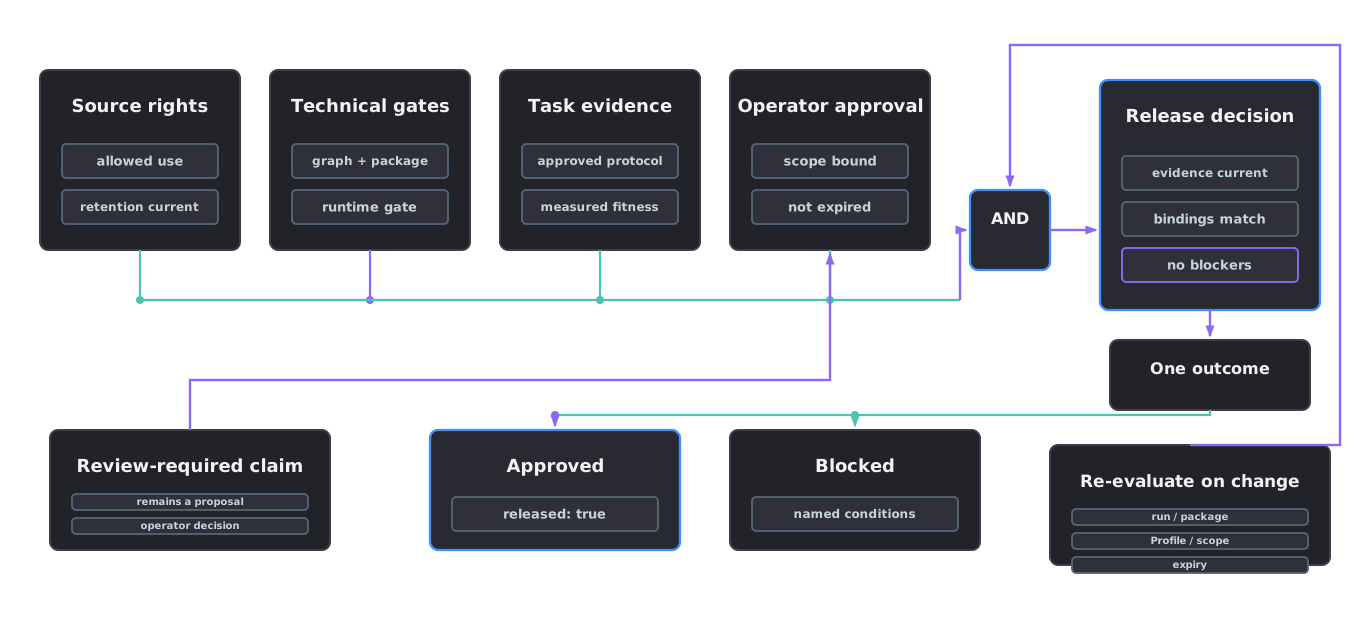
The decision records a timezone-aware evaluated_at value and a fixed evaluation order. Rights, fixed-period retention and the operator decision must all remain current at that instant. An expired rights grant, reached retention deadline, reviewer timestamp after the evaluation time or expired operator decision blocks release.
Promotion decisions
validated: required evidence exists and gates passed.review_required: a reviewer must accept uncertainty or missing strength of evidence.blocked: release is not allowed until the named condition changes.
Worked example: releasing the walkthrough project
The walkthrough project proposes a mass value for the jerrycan from visual evidence alone, so material inference marks it review_required, and the workflow keeps the governance release status blocked. A release decision cannot waive that technical blocker. The decision does not live in a stage manifest because the workflow regenerates those files. The command derives a decision from current project state and writes a content-addressed history record plus a current pointer after the missing evidence has been supplied.
Preview the exact decision before writing it:
afb governance decide \
  --project projects/metal_jerrycan \
  --reviewer operator@example.org \
  --decision approve \
  --scope rigid_body_manipulation \
  --expires-at 2026-08-01T00:00:00Z \
  --note "Source rights and current evidence graph reviewed" \
  --note "Materialised mass evidence and physics validation reviewed"
The preview contains a content-derived decision_id, current run_id, request digest, asset fingerprint, exact Profile ID and version, scope and expiry. If any binding is blank or wrong, do not author the file. Repeat the command with --write only after the preview has been reviewed. The write creates:
operator-release-decision.json, the current decision pointergovernance-decisions/<decision-id>.json, the immutable history record
On the next rebuild or agent run, the governance stage recomputes the release state:
- the isaac-load gate result is read from
reports/isaac-load-check.json reports/project-graph-validation.jsonandreports/pre-release-graph-validation.jsonmust have no graph errorsreports/task-fitness-evidence.jsonmust match the current run, fingerprint, Profile and release scope- the operator decision is read from
operator-release-decision.json - its content ID, expiry and all bindings are recomputed
- any remaining stage or validation blockers are collected
The governance record changes to release_status: approved with released: true only after every required gate passes, generated artefact validation is validated and the bound decision says approve. A new run, package change, Profile change, scope change or expiry invalidates the current decision automatically.
Persistence rules:
- The stage manifests are never edited retroactively; a proposal from visual inference stays labelled as such, and the decision file records who accepted it and under what conditions.
- Notes carry concise, non-secret conditions of acceptance for comparison with the evidence available at decision time.
- Gate results survive rebuilds through their reports;
afb isaac-load applyrecords the load check once and every later rebuild rehydrates it.