Orchestrator
The orchestrator converts a run request into a dependency-closed DAG. The plan records versioned stage contracts, provider assignments, validation gates, W&B settings and stop conditions.
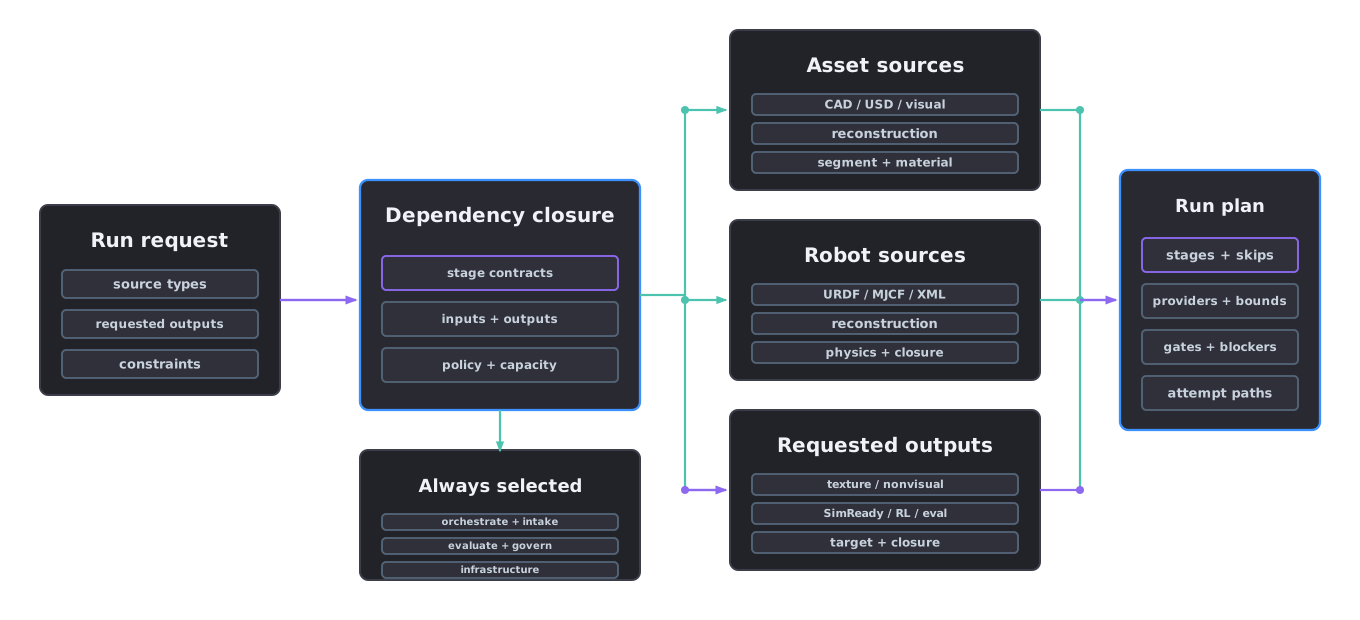
Route selection
CAD, image-only, articulated robot and texture-variation requests take different routes. The orchestrator records the selected route, skipped stages, missing evidence and provider choices before mutation starts.
How to read a plan
Agent skill: asset-factory-orchestrator. This is the primary route through the factory; it usually selects the stage skills, provider assignments and validation gates for the whole run.
run-plan.json records:
- which stages will run
- which stages are skipped and why
- which providers or local runners are assigned
- which validation gates apply
- which typed deliverables each stage consumes and produces
- which executor, resource bounds and retry policy apply
- what evidence is missing before release
Resolve missing evidence in a blocked plan before running downstream stages.
Routing
Stages are selected by source suffix and requested outputs:
- CAD and USD sources route through reconstruction or conditioning, then mandatory mesh verification before their geometry can be treated as canonical.
- URDF and robot description XML route through source-ingestion, physics-articulation, simready-verification and rl-environment.
- Images, video, point clouds and raw meshes route through source-ingestion, reconstruction, material-inference and evaluation.
- Selecting material-inference always selects segmentation as well.
- Texture, variant, deformation and decal terms in the requested outputs select texturing.
- Thermal, acoustic, electrical and nonvisual terms select nonvisual-materials.
- SimReady, OpenUSD and USD package terms select simready-verification.
- RL terms select rl-environment together with simready-verification.
Orchestrate, intake, governance, evaluation and infrastructure are always selected.
Inputs
run-request.schema.jsonconfigs/agent-workflow.jsonconfigs/provider-policy.jsonconfigs/skill-registry.jsonconfigs/validation-gates.jsonconfigs/stage-contracts.json
Output files
run-plan.jsonprovider-assignment.jsonvalidation-plan.jsonmissing-evidence.jsonwandb-run-plan.jsonruns/<run-id>/request.json,plan.json,provenance.jsonandevents.jsonlruns/<run-id>/attempts/<stage-id>/<attempt-id>/
Telemetry plan
wandb-run-plan.json names the run, reporting stages and artefact lineage for Weights and Biases. Nothing is sent unless AFB_WANDB_ENABLED is set and WANDB_API_KEY is exported; AFB_WANDB_PROJECT and AFB_WANDB_ENTITY select the destination. When telemetry is off, the file records what a later connected run would log. Regenerate it with afb wandb-plan --run-plan ... --output ....
Ordering
Ordering comes from depends_on, consumes and produces in the stage contract registry. A stage cannot publish a successful attempt while a required deliverable is unavailable. Every terminal attempt records resolved inputs, environment and resource checks, output snapshots, validation gates and error codes. Segmentation carries the segmentation-segments gate, simready-verification carries static and runtime conformance gates and every content stage carries the VLM sign-off gate served by the agentic loop.
Stop conditions
The orchestrator blocks or flags a stage when required source evidence, provider policy, unit policy, schema support or upstream promotion state is missing. A blocked plan records why the run cannot proceed.