Manifest contracts
Manifest contracts are the file-backed interface between stages. They let a project be resumed, reviewed, validated and replayed without relying on process memory.
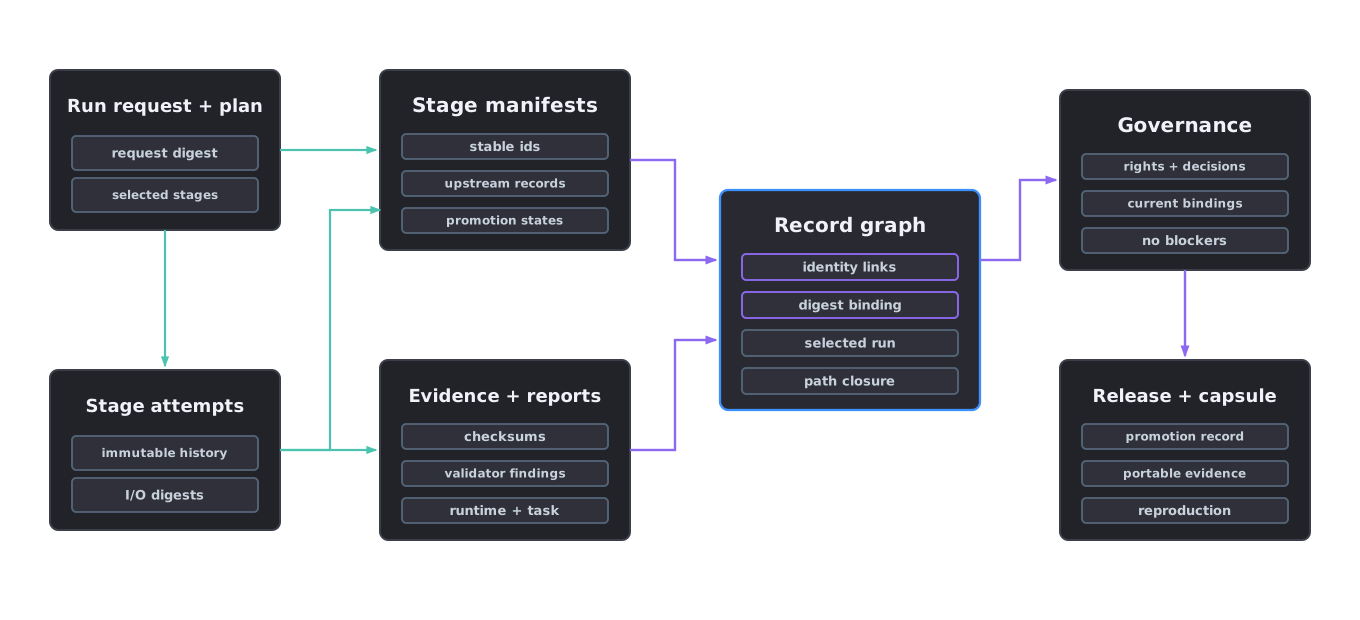
Manifest authority
Stages can produce geometry, materials, textures, physics, articulation and environment artefacts. The schema catalogue records what each stage received, produced and used as evidence, plus whether the result may move forward.
How to read a manifest
Agent skill: evaluation-validation-lead. The orchestrator usually hands manifests to validation as each stage completes.
Read a manifest from top to bottom before looking at generated files. The manifest should name the stage, inputs, outputs, evidence, validation state and review state. If a file exists but is missing from the manifest, treat the file as unmanaged.
For a quick check:
Authoring flow
- Pick the schema for the stage output.
- Generate a skeleton when starting a new manifest.
- Fill required fields from project evidence and service output.
- Validate against JSON Schema before downstream stages consume it (Wright et al., 2022)1.
- Record errors as report artefacts rather than console-only failures.
Stage manifests
Each project writes stage manifests as manifests/<schema-name>.json. The geometry boundary uses reconstruction-manifest for candidate geometry and mesh-verification-record for checksum-bound promotion to canonical geometry. The remaining pipeline stage manifests cover segmentation, material inference, texturing, physics and articulation, nonvisual materials and SimReady verification. Cross-cutting records cover the run request, immutable stage attempts, evaluation, governance, provenance, external models, runtime evidence, layout, mutation, skills, review, library and task-fitness contracts.
Contract rules
- Required IDs are stable across reruns.
- Paths resolve under the project, approved cache or approved library root.
- Units are explicit where physical values appear.
- Evidence IDs point to durable records.
- Proposal, review-required, validated and blocked states are distinct.
- Secrets never appear in manifests.
Commands
afb schema list
afb schema skeleton source-asset-manifest --output artifacts/source-asset-manifest.json
afb manifest validate source-asset-manifest artifacts/source-asset-manifest.json
Release dependency
A release record is only meaningful when its upstream manifests are valid. The governance record can then cite validated stage records instead of restating every technical detail.
References
-
Wright, A. et al. (2022) JSON Schema: A media type for describing JSON documents. Available at: https://json-schema.org/draft/2020-12/json-schema-core (Accessed: August 27, 2026). ↩