Layer ownership and variants
Layer authority is explicit. Tools write only to their owned layer family.
Review boundaries
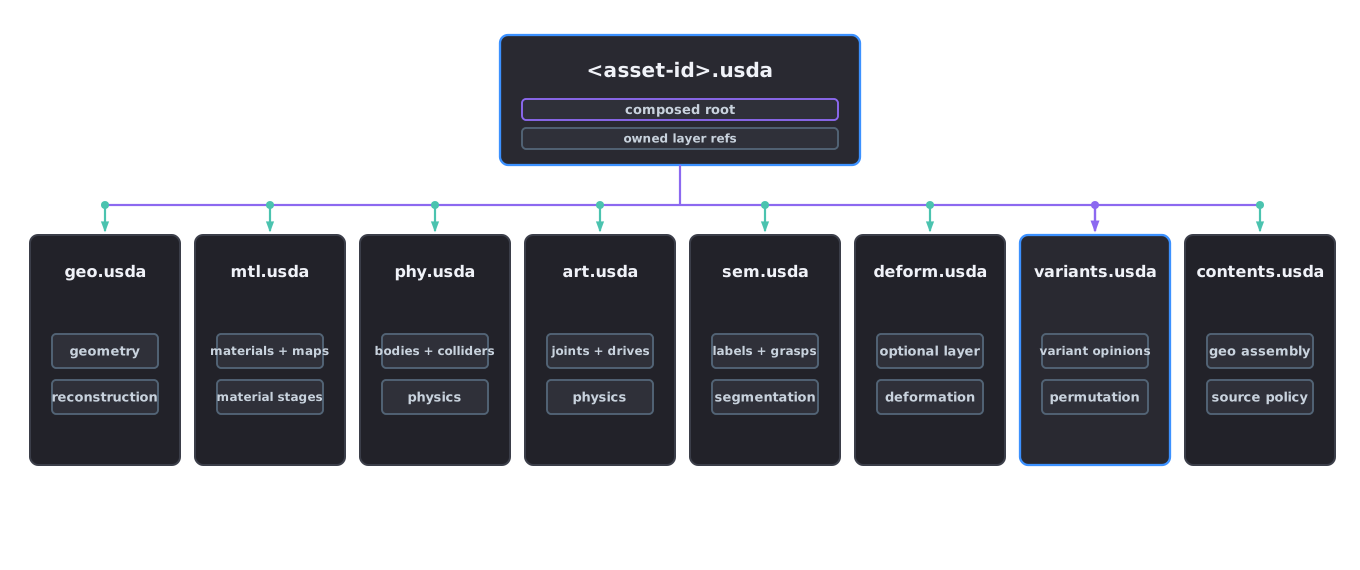
Arbitrary writes across geometry, material, physics, articulation, semantic and variant opinions obscure which stage owns a change. Layer ownership assigns each opinion to a stage, while variant definitions bound the permitted permutations.
Asset layers
geo.usda: source or reconstructed geometry, owned by reconstructionmtl.usda: material definitions, bindings and texture outputs, owned by material inference and texturingphy.usda: rigid bodies, colliders, mass and physics materials, owned by physics-articulationart.usda: joints, drives, limits and articulation roots, owned by physics-articulationsem.usda: labels, affordances, task metadata and provenance hooks, fed by segmentationdeform.usda: dent, bump and displacement request opinions for generated geometry variantsvariants.usda: material, geometry, physics, articulation and domain-randomisation variantscontents.usda: assembly references
Grasp affordances are recorded in the physics-articulation manifest and surfaced as semantics in sem.usda.
Mutation rules
- Ambiguous write targets return
blocked_needs_target. - Deletes scan active and inactive variant bodies.
- Renames update owned variant bodies and relationship targets.
- Asset or path attributes validate target files before authoring.
- Variant deletion requires explicit approval when only one effective choice remains.
Variant role
Variants let the same asset support policy training across visual, physical and layout differences. Each variant must keep the base asset lineage and define its bounds so randomisation stays reviewable.
Validation
configs/tool-surface.json encodes layer authority, including prefix and service ownership.