Libraries
Libraries index operator backings such as material folders, texture sets, USD assets, an Omniverse content estate, a USD Search endpoint and remote free sources. Agents use those indexes to ground asset, material, texture and property choices.
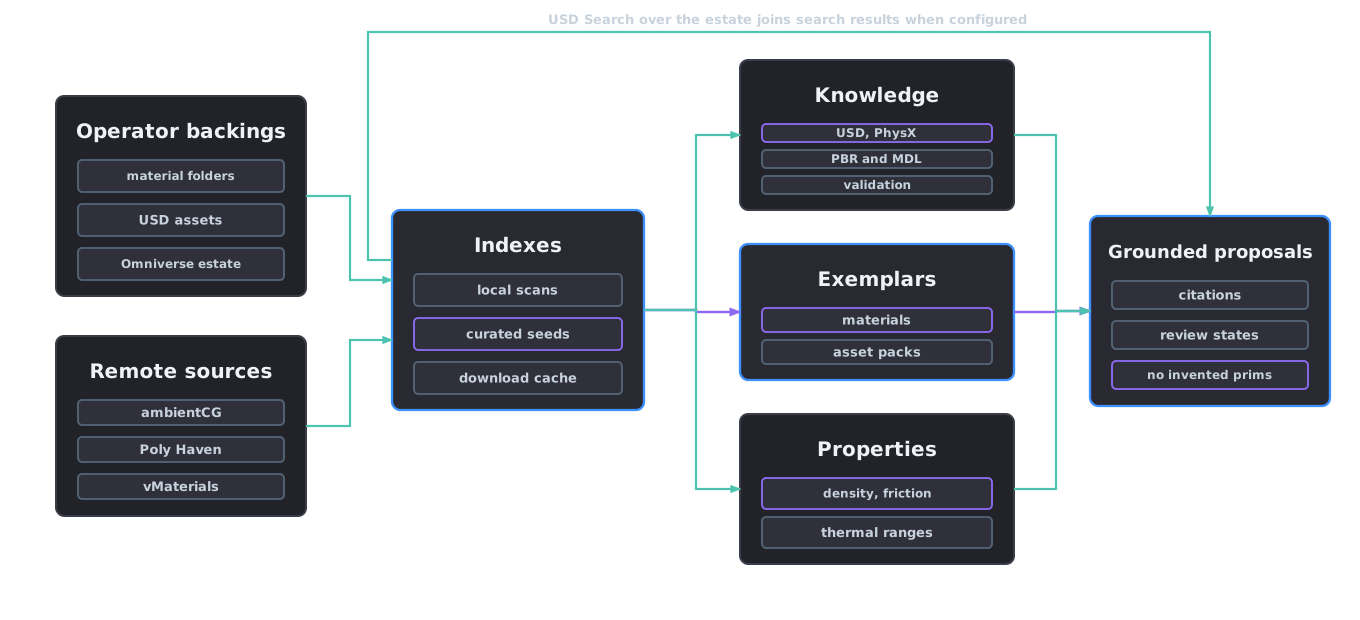
The grounding rule
Every authored prim path, schema name, material, texture channel and physical value traces to a knowledge document, exemplar entry, indexed local asset, configured estate search hit or measured record. Items without grounding are flagged ungrounded and require review. The library_grounding record on material proposals and the library: evidence IDs on property proposals carry this trace.
The pipeline can run without library backings, but ungrounded items require review.
Backings
configs/library-registry.json declares the backings; operators add their own in library/local/backings.json without touching tracked config. Kinds:
local_folder: operator folders resolved through environment handles (AFB_MATERIALS_ROOT,AFB_TEXTURES_ROOT,AFB_USD_ASSETS_ROOT,AFB_OMNIVERSE_CONTENT_ROOT).afb library indexscans them for MDL modules, USD files and PBR texture sets (channel naming is recognised and grouped into sets) into indexes underlibrary/local/.usd_search: a USD Search API endpoint indexing the operator's estate, configured throughAFB_USD_SEARCH_URLandAFB_USD_SEARCH_API_KEY. Search results join library hits for USD assets.remote_pack_source: API-backed free sources (ambientCG and Poly Haven, both public domain) that can be queried and downloaded from.manual_pack: catalogues obtained through their own channels, such as vMaterials; once installed locally, the same folder indexing applies.
What ships in the seeds
The repository ships four curated indexes under library/, all in the same item-record shape (item_id, name, domain, source, tags, licence and domain-specific fields), so search treats seeds, operator indexes and remote hits uniformly.
| Seed file | Entries | What each entry carries |
|---|---|---|
material-exemplars.json |
20 exemplar materials | material class, tags and format for common industrial surfaces: brushed and galvanised steels, painted and rusted metals, aluminium, plastics, rubbers, woods, concrete, glass and fabrics, patterned on the Omniverse reference catalogues |
physical-properties.json |
21 material classes | per-class ranges with units for density, friction, restitution and related properties (props_steel, props_aluminium, props_rubber and so on); material inference draws review-gated library_prior evidence from these ranges, never point values |
asset-packs.json |
10 pack links | curated pointers to existing asset, material and texture collections (NVIDIA SimReady warehouse assets, ambientCG, Poly Haven and peers) with licence and pack domains, so a reconstruction target such as an industrial ladder can be compared against pack exemplars |
knowledge/ |
5 documents plus index.json |
the agent knowledge corpus: usd-fundamentals.md, asset-creation.md, validation.md, physx-binding.md and pbr-mdl-materials.md, indexed for search so agents cite how USD, validation, physics binding and PBR and MDL authoring work here |
The seeds cover the bundled examples and define the extension format. Production materials databases require additional entries.
Adding library content
Index existing content
Declare backings in library/local/backings.json, which is untracked and operator-owned, or through the environment handles. Then index them:
{
  "backings": [
    {"backing_id": "studio_materials", "kind": "local_folder", "domain": "materials", "path": "D:/content/materials"},
    {"backing_id": "studio_usd", "kind": "local_folder", "domain": "usd_assets", "path": "//nas/usd-library"}
  ]
}
Indexing scans for MDL modules, USD files and PBR texture sets. Recognised channel names are grouped into sets. The resulting *-index.json files under library/local/ join the seed indexes in search.
Download from free sources
afb library fetch --source ambientcg --query "rusty metal" --limit 3 --live pulls query-responsive items. afb library shop opens the terminal selector across sources and packs. Downloads land under library/downloads/ with checksums and licence records, then join the cache index.
Search the estate
With AFB_USD_SEARCH_URL configured, estate hits join local results on every search and remain available as remote grounding references.
Extend the curated seeds
Seed files are tracked contracts. Add entries in the same item-record shape and commit them like any other config change. A new property class must carry ranges with explicit units, never single values, so downstream proposals stay review-gated. Add knowledge as a Markdown document under library/knowledge/ and register it in knowledge/index.json.
Searching and fetching
afb library search --query "rusty metal"
afb library search --query "industrial ladder" --domain usd_assets --remote
afb library backings
afb library index
afb library fetch --source ambientcg --query "rusty metal" --limit 3 --live
afb library shop --query "rusty metal"
afb library shop
afb library shop lists query-responsive items from API-backed sources or registered packs. Numbered selections accept all or ranges such as 1,3-5, then require confirmation before planning or downloading. Downloads land under library/downloads/ with checksums, join a cache index and stay out of version control. Fetches are plan-first; --live performs them. Licences travel with every item, and mixed-licence sources require rights checks before use beyond visual reference.
The agent-facing tools mirror the commands: asset_library_search, asset_library_index and asset_library_fetch.
How stages use the library
- Reconstruction compares targets against asset pack exemplars and estate search hits for part structure and proportions.
- Material inference grounds candidates in the exemplar index and records
library_groundingper component; ungrounded materials require review. - Physical property proposals cite dictionary entries as
library_priorevidence with ranges and stay review gated. - Texturing resolves texture sets from indexed backings and cached pack downloads before generating new maps.
- VLM reviewers receive exemplar references in stage context for review decisions.