SimReady verification
The final stage assembles a SimReady candidate, verifies the USD and records the evidence required before any scoped promotion claim.
What must pass before an asset is SimReady?
An asset can be promoted only when it matches an exact SimReady Profile, passes the applicable Requirements, loads in the named runtime, closes package dependencies and demonstrates fitness for its declared task (NVIDIA Corporation, no date)1. Repository checks produce evidence for that decision, but they do not by themselves constitute NVIDIA certification.
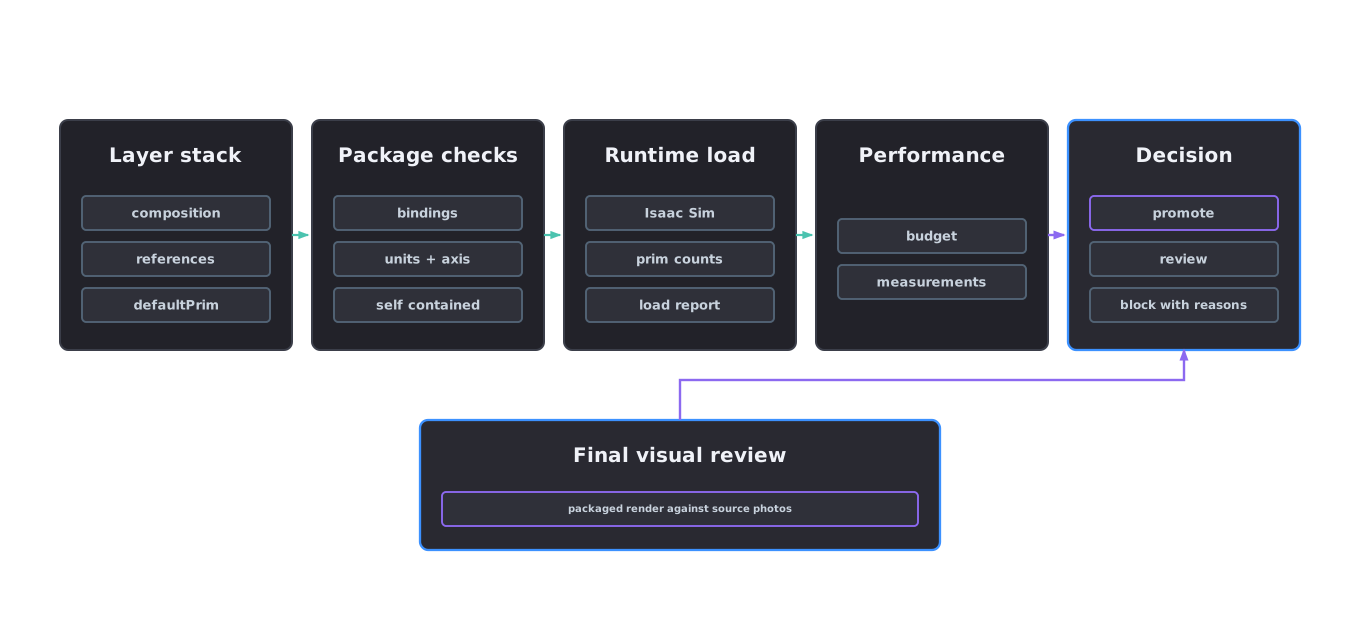
Promotion boundary
SimReady status is a promotion state. A candidate must carry an exact Profile, pass the applicable Requirements, load in the named runtime, close every package dependency and prove fitness for its declared task before it can support a release claim. A filename or local-validator result cannot confer that status. Repository checks provide evidence without constituting NVIDIA certification.
Run the gate
Agent skill: simready-verification-lead. The orchestrator reaches this gate after segmentation, material, texturing and physics-articulation records are present.
Run readiness after upstream stages have written their manifests. The report expresses the release decision and its blockers.
If the report is blocked, fix the named missing record before rerunning. Visual correctness cannot replace missing load, layer, physics or governance checks.
Verification checks
- units and up axis
- default prim
- layer stack completeness and reference resolution
- current OpenUSD
UsdValidationregistry results, including the registered validator inventory, bound to the root digest (Alliance for OpenUSD, no date a)2 - canonical Preview Surface material, unbound MaterialX sidecar status and texture colour-space records (Smythe and Stone, 2025; Alliance for OpenUSD, no date b)3 4
- clean package replacement plus exact declared-file, USD, MaterialX and non-layer dependency closure
- current
SemanticsLabelsAPI:<taxonomy>labels (NVIDIA Corporation, no date)5 - applied physics schemas
- articulation roots, defined and enabled rigid-body targets, collider coverage, evidence-backed local frames, axes, limits and bounded typed drives
- texture paths
- render evidence
- performance budget
- an exact NVIDIA Profile result with versioned Feature and Requirement findings
- task-fitness evidence for the declared release scope
- cross-record graph integrity before release
Official Profile validation
Configure the trusted NVIDIA Omni Asset Validator CLI (NVIDIA Corporation, no date)6, then validate the composed root against the exact Profile recorded in the asset manifest. The current NVIDIA validator distribution exposes nvidia_usd_validate; pin and record the installed package version and executable digest.
export AFB_ASSET_VALIDATOR_EXECUTABLE="$(command -v nvidia_usd_validate)"
export AFB_ASSET_VALIDATOR_EXECUTABLE_SHA256="$(sha256sum "$AFB_ASSET_VALIDATOR_EXECUTABLE" | cut -d' ' -f1)"
export AFB_VALIDATION_ATTESTATION_SECRET="$(openssl rand -base64 32)"
afb simready validate-profile \
  --usd projects/<slug>/packaged/<asset-id>/<asset-id>.usda \
  --profile-id <profile-id> \
  --profile-version <profile-version> \
  --raw-output projects/<slug>/reports/simready-profile-validation.raw.json \
  --output projects/<slug>/reports/simready-profile-validation.json
Use the executable digest from an administrator-approved installation. The report producer cannot select it. Keep one stable attestation secret in the deployment secret manager and make it available to both production and later evidence verification. Keep it out of the project and report. The bridge removes this secret from the validator child-process environment.
The bridge runs a bounded process with the shell and fix operation disabled; source files remain immutable. Raw and normalised reports must sit outside the immutable package directory. The normalised report binds the result to the root USD SHA-256, complete composition fingerprint, exact package-inventory fingerprint, administrator-pinned executable digest and exact Profile identity. Passing reports also carry a deterministic HMAC-SHA256 attestation over their canonical content. The inventory includes textures, MaterialX and other non-layer package files. A pass requires the requested Profile to appear exactly once and the vendor report to supply passing, versioned evidence for every Feature and Requirement beneath it. The unmodified vendor JSON remains the separate audit source. A missing pin, missing attestation secret, malformed report, unknown Profile or incomplete requirement tree remains blocked.
The script wrapper scripts/simready/run_official_profile_validator.py exposes the same bridge for environments that do not install the afb entry point.
Fitness for use
Task adequacy requires evidence beyond Profile conformance and runtime loading. Generate a schema-valid, blocked template carrying the exact current bindings:
afb fitness template \
  --project projects/<slug> \
  --output projects/<slug>/reports/task-fitness-template.json
First materialise an approved task-fitness-protocol record under the project. The protocol names its authority, approval ID, approval time, scope, scenarios, metric units, ranges and tolerances. Its digest is bound into the fitness report, so the report submitter cannot choose different thresholds around an observed value. Run the required scenario outside the factory, replace the unmeasured template fields with measured metrics and content-addressed evidence records, then apply the result:
The evaluator resolves the protocol and every evidence file inside the project, verifies their SHA-256 digests and content-derived IDs, requires exact test and metric coverage and recomputes every result from the approved protocol. A report for another run, request digest, package fingerprint, Profile or release scope cannot pass. The named protocol authority owns the acceptance thresholds; the blueprint supplies none.
Record graph
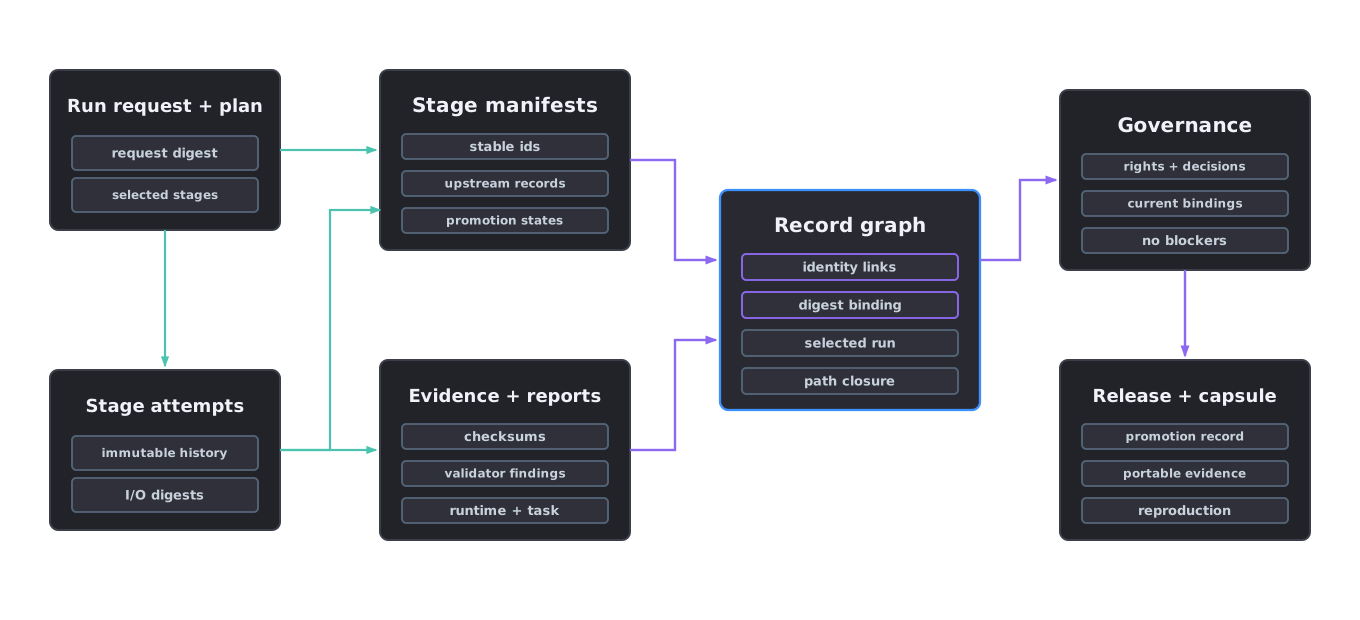
Run afb project validate --project projects/<slug> after applying external evidence. The validator walks the run request, run plan, immutable attempts, manifests, evidence references, checksums, provenance and release records. record-graph remains blocked when an identifier, digest, path or selected-run reference is inconsistent even if each individual JSON file is schema-valid.
Runtime targets
Isaac Sim is one concrete runtime target. Its load check (scripts/simready/isaac_load_check.py) feeds the isaac-load gate:
Inject the same independent AFB_ISAAC_ATTESTATION_SECRET from the managed secret store into the producer and consumer environments. It must contain at least 32 UTF-8 bytes and must not reuse the official-validator attestation secret. Set AFB_ISAAC_PRODUCER_SHA256 in every producer and consumer environment to the administrator-approved lowercase 64-hex SHA-256 of scripts/simready/isaac_load_check.py. A producer whose own script bytes do not match that pin cannot pass.
<isaac-sim>/python.bat scripts/simready/isaac_load_check.py \
  --usd projects/<slug>/packaged/<asset-id>/<asset-id>.usda \
  --profile-id <profile-id> \
  --profile-version <profile-version> \
  --output projects/<slug>/reports/isaac-load-check.json
afb isaac-load apply --project projects/<slug> --report projects/<slug>/reports/isaac-load-check.json
Use the exact simready_profile.profile_id and simready_profile.profile_version values from the asset manifest. The runtime report carries fixed report and protocol identities, a portable project:/// USD label, producer and Isaac runtime identities and a versioned HMAC-SHA-256 attestation over canonical JSON. The signature input is the protocol-specific context asset-factory-isaac-runtime-validation-attestation-v1, a NUL byte and the canonical report bytes. The importer verifies the exact attestation shape, schema, producer pin, HMAC, Profile, USD digest and package inventory before it writes project state. The canonical SimReady consumer independently repeats the schema, producer-pin, identity and HMAC checks whenever it reads the report. A report for another Profile, package, protocol, producer or key does not satisfy this gate.
The result is recorded in the manifest as isaac_sim_load_check.
Manifest
manifests/simready-asset-manifest.json records package ID, USD root, layer stack, units, axis policy, upstream manifest IDs, exact Profile, Feature and Requirement results, OpenUSD compliance, articulation schema evidence, official-validator evidence, runtime evidence, performance budget and promotion status. reports/package-dependency-closure.json records the transitive USD and MaterialX package closure.
Promotion states
validated: required checks passed and governance allows release.review_required: the package loads, but a reviewer must accept a weak or task-critical claim.blocked: a required record, artefact or gate is missing or failed.
References
-
NVIDIA Corporation (no date) SimReady FAQ. Available at: https://docs.omniverse.nvidia.com/simready/latest/simready-faq.html (Accessed: July 9, 2026). ↩
-
Alliance for OpenUSD (no date a) OpenUSD validation framework. Available at: https://openusd.org/dev/api/md_pxr_usd_validation_usd_validation__r_e_a_d_m_e.html (Accessed: July 9, 2026). ↩
-
Smythe, D. and Stone, J. (2025) MaterialX: An open standard for network-based CG object looks. Available at: https://materialx.org/Specification.html (Accessed: August 27, 2026). ↩
-
Alliance for OpenUSD (no date b) UsdMtlx: MaterialX file format and shader plugins. Available at: https://openusd.org/release/api/usd_mtlx_page_front.html (Accessed: July 9, 2026). ↩
-
NVIDIA Corporation (no date) Semantic label schema requirement. Available at: https://docs.omniverse.nvidia.com/kit/docs/asset-requirements/latest/capabilities/semantic_labels/requirements/semantic-label-schema.html (Accessed: July 9, 2026). ↩
-
NVIDIA Corporation (no date) Asset validator command-line interface. Available at: https://docs.omniverse.nvidia.com/kit/docs/asset-validator/latest/source/python/docs/cli.html (Accessed: July 9, 2026). ↩