Segmentation and semantic inference
Segmentation splits an asset into stable, semantically labelled regions. Image priors may condition reconstruction, but the segmentation stage consumes only canonical geometry approved by mandatory mesh verification. Every later material, texture and physics decision can therefore point at a reviewed named part.
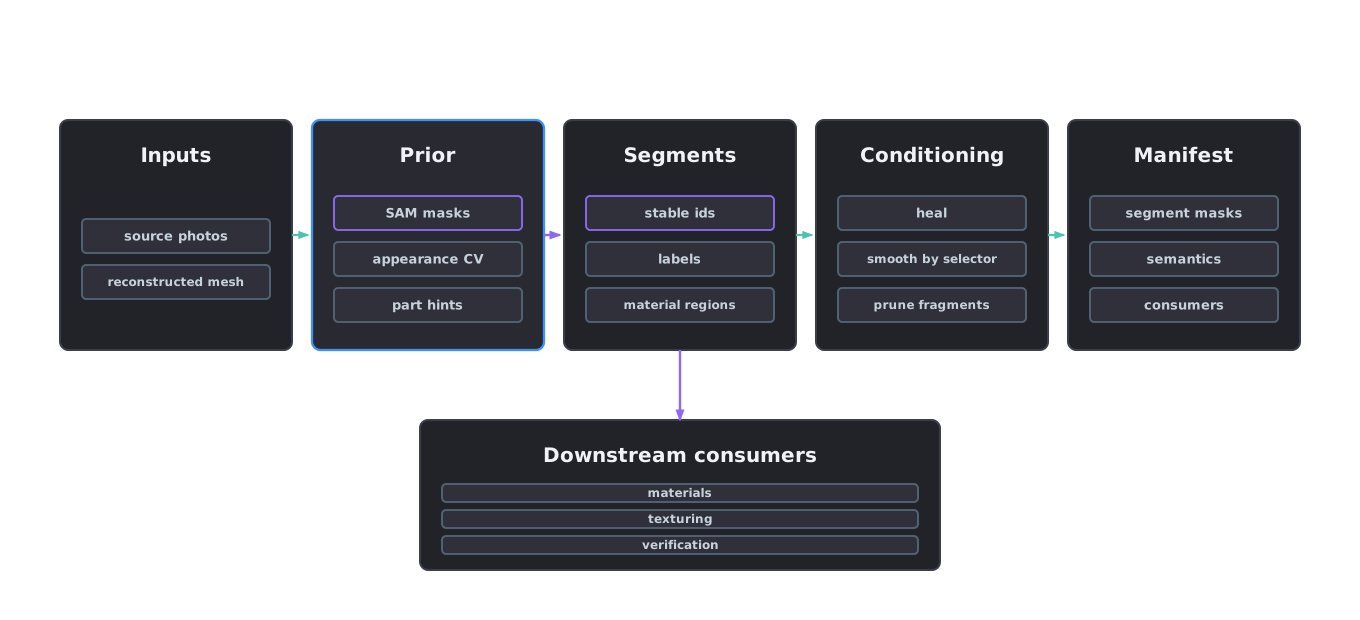
Stable segment identities
Material inference, texturing, decal placement and grasp reasoning operate on named asset regions. A mug body and handle have different materials, textures and grasp affordances. Segmentation assigns stable ids, semantic classes and masks that survive reconstruction upgrades.
Invoke segmentation
Agent skill: segmentation-lead. Tools: asset_image_segmentation_prior and asset_mesh_condition. The orchestrator selects this stage whenever material inference is planned.
Image segmentation priors
Before reconstruction, asset_image_segmentation_prior splits a source image into appearance or SAM-derived region masks (Kirillov et al., 2023)1. Its outputs are semantic masks, an overlay, a conditioning image and a manifest with the suggested part count.
Use the prior before PartCrafter when material or appearance regions should influence the generated part structure. PartCrafter exposes no native mask input. The conditioning image and part count carry the prior; downstream validation scores the generated parts against the masks.
Appearance and material-region segmentation
- Read the source asset, reconstruction result and material cues.
- Propose stable appearance segments with ids, labels, semantic classes, material hints and confidence.
- Write segment masks under
assets/<asset>/textures/segments/. - Author
SemanticsLabelsAPI:classandSemanticsLabelsAPI:labeltoken arrays on the asset root and segment prims insem.usda(NVIDIA Corporation, no date)2. - Hand the segment records to material inference, texturing and SimReady verification.
Segment ids remain stable across later reconstruction upgrades. If geometry supports separate prims or mesh subsets, those prim paths replace the mask-only material-region proposal while the same segment ids, material regions and semantic labels remain valid.
Legacy assets that authored string-valued SemanticsAPI:<instance> properties must be migrated on a project copy:
afb semantics migrate \
  --source <legacy-root.usd> \
  --output <migrated-root.usda> \
  --report <semantic-migration-report.json>
The command flattens the source composition into a distinct output, replaces legacy applied schemas with SemanticsLabelsAPI:<taxonomy> token arrays and records every migrated prim. The source file remains immutable. Unreadable composition or unsupported semantic values leave migration blocked.
Semantic mesh conditioning
asset_mesh_condition heals reconstructed mesh files and applies deterministic shape operations only to meshes selected by material, segment or prim metadata. Healing can run across all listed meshes; dents, bumps and smoothing must carry an explicit selector such as material_family, material_name, segment_id or prim_path so geometry edits stay material-aware. The tool writes a report, manifest, checksums and conditioned mesh outputs, all as proposal geometry until visual and USD validation passes.
The supporting script lives at scripts/segmentation/condition_usd_mesh_segments.py.
Manifest
manifests/segmentation-manifest.json records:
appearance_segmentswith ids, labels, semantic classes, material hints and confidencesegment_maskswith mask paths and checksumsmaterial_regionsbinding segments to prim paths and material names- downstream consumers: material-inference, texturing and simready-verification
Gates
- segments carry masks, semantic labels and material targets (
segmentation-segmentsgate) - segment ids are stable
- mesh conditioning operations carry explicit selectors
- source lineage is recorded
References
-
Kirillov, A. et al. (2023) "Segment anything," Proceedings of the IEEE/CVF international conference on computer vision, pp. 4015–4026. Available at: https://openaccess.thecvf.com/content/ICCV2023/html/Kirillov_Segment_Anything_ICCV_2023_paper.html. ↩
-
NVIDIA Corporation (no date) Semantic label schema requirement. Available at: https://docs.omniverse.nvidia.com/kit/docs/asset-requirements/latest/capabilities/semantic_labels/requirements/semantic-label-schema.html (Accessed: July 9, 2026). ↩