Nonvisual materials
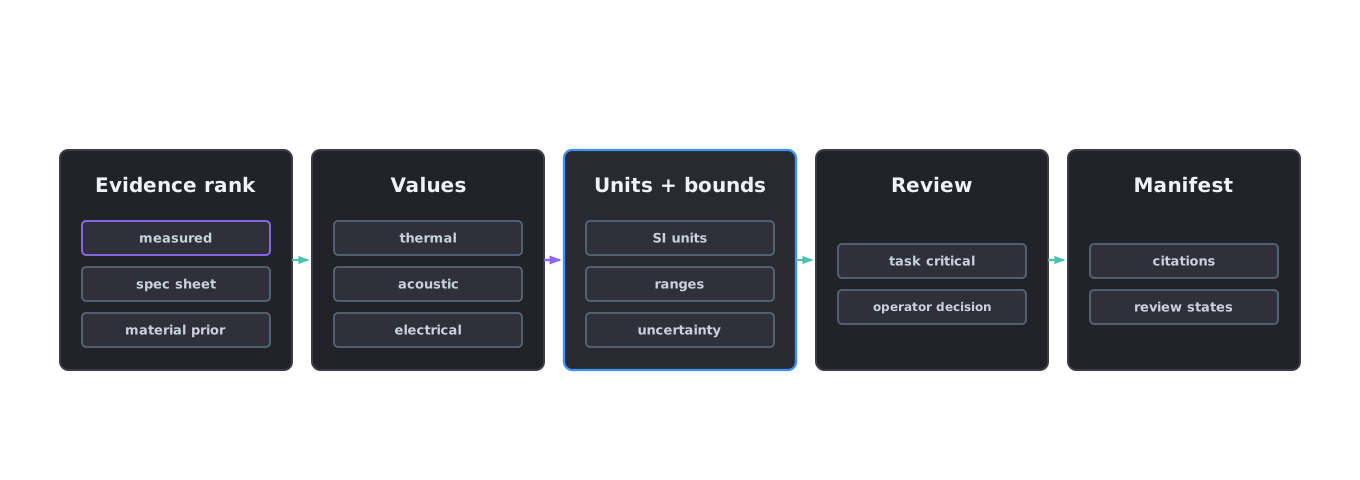
The optional nonvisual-materials stage infers hidden thermal, acoustic and electrical behaviour. Pixels may support a proposal; hidden physics requires independent evidence.
Scope
Covered nonvisual material properties:
- thermal: conductivity, heat capacity
- acoustic: absorption
- electrical: conductivity, permittivity
- similar hidden material behaviour
Mechanical properties needed for physics, such as mass, density, friction and stiffness, are proposed in stage 3 material inference and authored in stage 5 physics-articulation. Their ownership remains with stages 3 and 5.
Hidden-property evidence
Thermal cameras, contact microphones and electrical sensing models depend on behaviour that renders cannot show. The nonvisual-material record captures those assumptions with units, uncertainty and evidence.
Evidence order
- measured values
- manufacturer specs
- BOM or catalogue
- material prior
- simulation tuning
- provider proposal
- manual review
Higher-quality evidence can promote a property. Lower-quality evidence can create a proposal, but task-critical values remain review-required until a reviewer accepts the risk or stronger evidence arrives.
Review hidden properties
Agent skill: nonvisual-materials-lead. Tool: physics_nonvisual_materials_propose. Provider role: nonvisual_material_reasoner. The orchestrator invokes this stage only when the task needs nonvisual material behaviour.
Ask whether the property affects the task. A rough thermal estimate for a decorative background object may be acceptable. An absorption value for an acoustic sensing task is task-critical and needs stronger evidence or review.
Check each value for:
- unit and range
- source method
- evidence ID
- confidence and uncertainty
- validation or review state
Process
- Collect candidate values from source evidence, material records and trusted priors.
- Record units, ranges, distributions and method.
- Attach evidence IDs and confidence.
- Mark weak, contradictory or task-critical values as review-required.
- Emit
manifests/nonvisual-material-manifest.json.
Property records
Each property records prim path, property name, group, value, unit, range, distribution, method, confidence, evidence IDs, validation status and notes.
Required outcomes
- units present
- uncertainty present
- source method present
- weak proposals stay review-required
- task-critical unknowns block release or require review