Deployment
Deployment covers operator hosting, secret handles and bounded request execution outside a one-off local command.
Operating model
Deployment lets operators review evidence, rerun gates and inspect project state across terminal sessions. Local and hosted runs use the same file-backed validation model. The HTTP process is an execution gateway with durable job records, not a workflow scheduler.
Deployment units
- CLI package installed from the repository
- bounded tool service bound to loopback or an authenticated approved host
- project workspace root
- provider policy file
- external model config
- durable job and approval ledger
- append-only audit destination
- separate bearer and reviewed-mutation approval secrets
Secret policy
Secrets are supplied through environment variables or deployment secret stores. Reports can record env var names, provider IDs, model IDs and redacted endpoint metadata. Reports must not record raw keys, bearer tokens, approval secrets or signed URLs. Job parameters and approval reasons are durable operational records and must contain only handles.
External agent hosts
scripts/afb-agent-launchable exposes the asset_programme_intake and asset_factory_start tools over the governed stdio surface for an external agent host. Start with the asset programme strategist to turn a brief into a run request.
Intake validates the draft without creating a project. Starting the factory creates a project and may enter live provider-backed work, so it requires the existing parameter-bound, single-use tool approval described below.
HTTP tool service
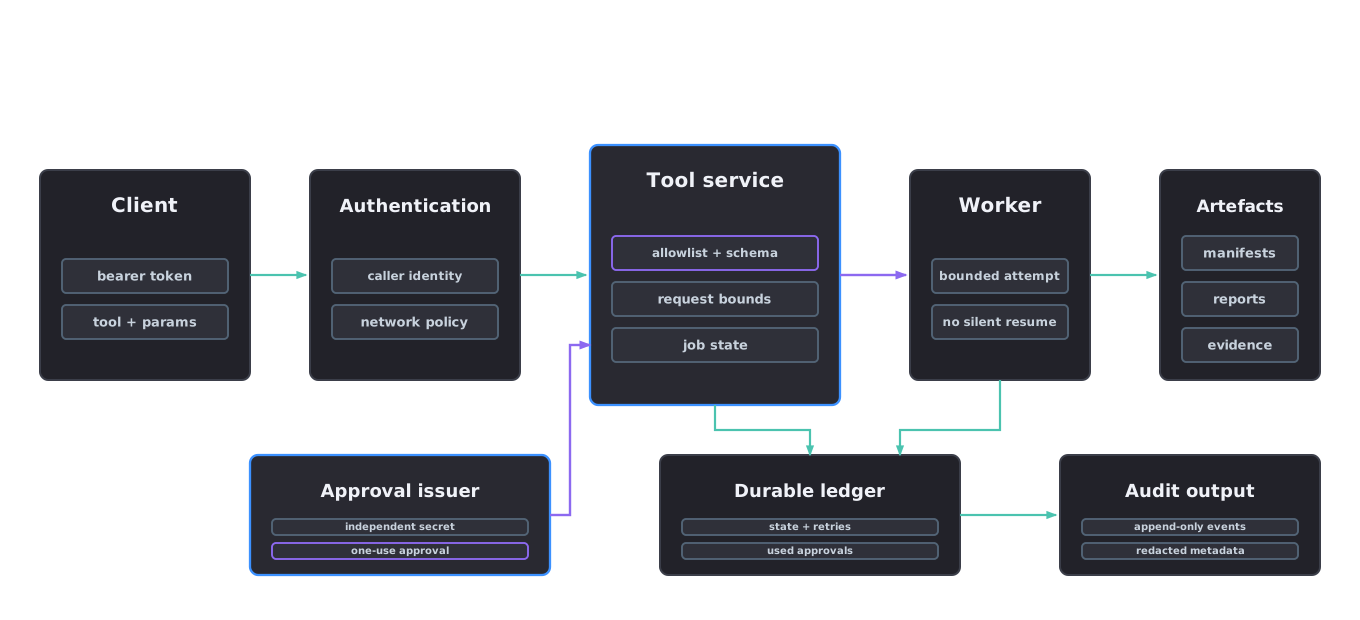
The service binds to loopback by default. It limits request and result size, HTTP threads, workers, retained jobs and retries. --job-store persists every job transition and consumed approval capability. On restart, recorded terminal jobs remain queryable and interrupted jobs become failed. The service never silently resumes an interrupted mutation.
afb tool-server --transport http --host 127.0.0.1 --port 8181 \
  --max-request-bytes 1048576 --max-result-bytes 4194304 \
  --max-http-threads 32 --max-workers 4 --max-retained-jobs 256 --max-retries 1 \
  --job-store artifacts/tool-server-state \
  --allowed-tools environment_capability_probe,asset_stage_run \
  --audit-log artifacts/tool-server-audit.jsonl
Set AFB_TOOL_SERVER_APPROVAL_SECRET to a random value of at least 32 bytes. The approval issuer runs separately from the server and binds a capability to the exact tool and canonical request parameters:
afb tool-approval issue \
  --tool asset_stage_run \
  --params-file reviewed-stage-request.json \
  --expires-at 2026-07-09T19:30:00Z \
  --approved-by operator@example.org \
  --reason "Reviewed stage mutation for run run-20260709-01"
The returned token expires within 24 hours and can be consumed once. Any parameter change invalidates it. A retry requires a new token. Approval is derived from the registered service effect, so setting dry_run never weakens the boundary.
Endpoints are:
| Method | Path | Purpose |
|---|---|---|
GET |
/healthz |
unauthenticated process health, durability mode and job counts |
GET |
/tools or /v1/tools |
governed tool catalogue |
POST |
/v1/jobs |
validate and submit {"tool": "...", "params": {...}, "approval_token": "..."} |
GET |
/v1/jobs/<id> |
read state and result |
POST |
/v1/jobs/<id>/cancel |
cancel queued work or record a request against running work |
POST |
/v1/jobs/<id>/retry |
create a bounded child attempt from a failed or cancelled job |
GET |
/v1/audit |
read the most recent in-memory audit events |
Running tools cannot yet be interrupted cooperatively. A cancellation request is recorded and the response says whether execution was cancelled before it started.
Set AFB_TOOL_SERVER_TOKEN to require bearer authentication. Non-loopback binding requires the bearer token, the independent approval secret and AFB_TRUSTED_TOOL_SERVER_NETWORK=1. Use a reverse proxy or service mesh for TLS, rate limiting and caller identity. The bearer authenticates the caller; the single-use capability authorises one reviewed mutation. They are deliberately different credentials.
The stdio transport accepts one JSON request per line. Operations are health, catalogue and synchronous invoke. It applies the same tool allowlist, exact schema validation, result bound and approval ledger as HTTP. It is intended for a local agent subprocess whose process lifetime is controlled by the caller.
Deployment templates
The Docker Compose and Kubernetes templates run one bounded HTTP replica and require bearer and approval secrets. Compose persists the job ledger in the mounted artefact directory. Kubernetes keeps it across container restart inside the pod, but the checked-in emptyDir does not survive pod replacement. Replace the artefact volume with a persistent volume claim for a durable deployment. Multiple replicas require an external scheduler and shared concurrency control.
Slurm, OSMO and Brev templates launch bounded batch commands. They do not provide a durable HTTP control plane. Provider credentials remain external to every template.
Release checks
afb provider check --policy configs/provider-policy.json
afb skill-audit --root . --output artifacts/skill-audit.json
Repository tests, the reproducibility benchmark and continuous integration live in this repository under tests/, benchmarks/ and .github/workflows/ci.yml.
Deployment should expose the same artefacts that local runs produce: manifests, reports, evidence, checksums and governance records.
See the support matrix before describing any deployment or simulator combination as release-verified.