Direct partial invocation
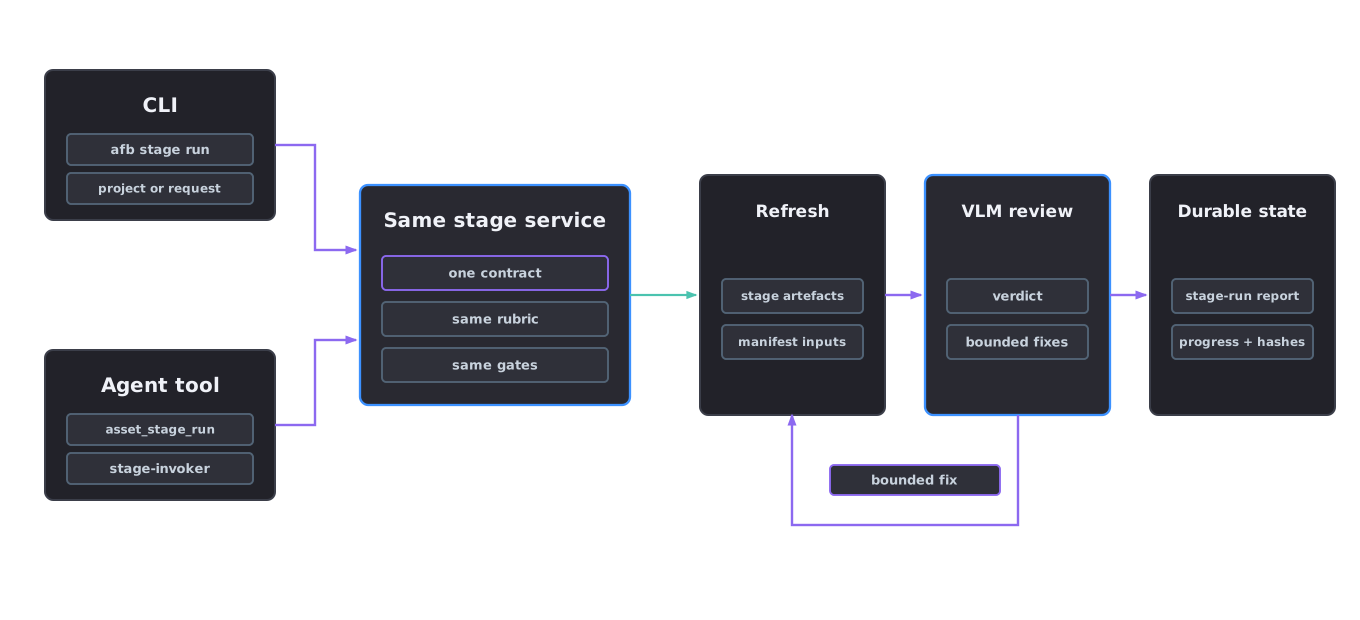
Direct partial invocation runs one pipeline stage with the same review, fix and progress contracts as the orchestrated loop. An agent calls the asset_stage_run tool; a person runs afb stage run. Both paths call the same service function and produce identical records.
Scope
Use the full loop for a fresh asset and direct invocation for a targeted change. Typical cases include re-texturing changed maps, reviewing a repaired mesh, rerunning segmentation with better masks or assigning stages to specialist agents. The same review, fix and progress rules still apply.
The CLI path
afb stage list
afb stage run texturing --project projects/metal_jerrycan --live
afb stage run segmentation --project projects/metal_jerrycan --live --max-fix-attempts 2
afb stage run material-inference --request examples/run-requests/jerrycan_from_photo.json --live
afb stage list shows every routed stage and whether it is directly invocable. afb stage run refreshes the workspace artefacts, runs the stage's VLM sign-off against its rubric, applies bounded fixes when the reviewer bounces the work and updates progress.json, the contact sheet and checksums. Without --live it is a dry run. --no-refresh reviews exactly what is on disk without rebuilding first. When the project does not exist yet, --request bootstraps the workspace and then reviews the one stage.
The agent path
The stage-invoker skill package teaches an agent the same operation through the asset_stage_run tool:
{
  "tool": "asset_stage_run",
  "params": {
    "stage_id": "texturing",
    "project": "projects/metal_jerrycan",
    "dry_run": false,
    "max_fix_attempts": 2
  }
}
The per-stage lead skills, such as texturing-lead and segmentation-lead, own the domain reasoning. Stage-invoker owns the invocation contract. A specialist agent can use the lead skill's tools before running the stage review through asset_stage_run.
What each stage exposes
| Stage | Invoke as | Domain tools an agent can also use directly |
|---|---|---|
| reconstruction | afb stage run reconstruction |
governance_external_model_run, backend runs via afb external-models run |
| mesh-verification | afb stage run mesh-verification |
governance_mesh_verify, asset_mesh_condition, reconstruction resubmission through the fix library |
| segmentation | afb stage run segmentation |
asset_image_segmentation_prior, asset_mesh_condition |
| material-inference | afb stage run material-inference |
material_propose, material_physical_properties_propose |
| texturing | afb stage run texturing |
material_texture_prompt, material_texture_variation_workflow, material_texture_defaults_validate |
| physics-articulation | afb stage run physics-articulation |
physics_plan, articulation_plan |
| nonvisual-materials | afb stage run nonvisual-materials |
physics_nonvisual_materials_propose |
| simready-verification | afb stage run simready-verification |
afb isaac-load apply, afb readiness |
Pre-pipeline and cross-cutting stages (orchestrate, intake, source-ingestion, evaluation, infrastructure, governance) have no review rubric and are not directly invocable; the tool refuses them and lists what is.
Results and state
The stage run writes reports/stage-run-<stage>.json with the full iteration record and returns final_state:
approved: the reviewer signed off with no blocking findings.review_required: held by the reviewer, skipped for a recorded reason or a dry run.blocked: rejected outright.escalated_to_review: fixes ran but none changed the artefacts.fix_attempts_exhausted: the remediation budget ran out.
Preserved invariants
- Rubrics, review record schemas and severity gates match the full loop; approvals have the same meaning on either path.
- Stage manifests are regenerated, never hand-edited; durable decisions stay in governance records and the operator release decision.
- Numeric physical values from visual evidence stay
review_requiredwhatever invoked the stage. - Every run refreshes the progress record and contact sheet, including partial runs.