IROS 2026 Spotlight
SynAirG
Generative Worlds for Adaptive Training of Bronchoscopy SLAM Models
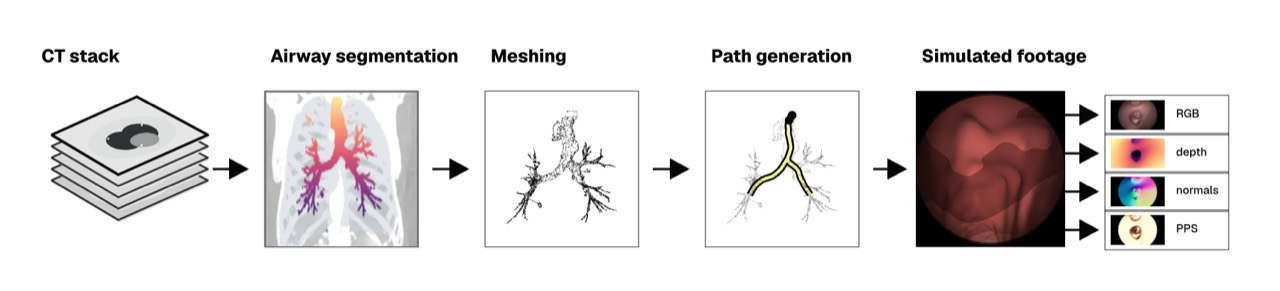
Overview
SynAirG turns generated or imported thoracic CT into physiologically plausible airway environments for bronchoscopy simulation, perception, simultaneous localisation and mapping (SLAM), and reinforcement learning. It connects airway anatomy, scope motion and rendered appearance in a single reproducible workflow.
Each case is defined by a YAML or JSON manifest. The same case can produce airway meshes, centreline graphs, camera trajectories, video, aligned condition frames and physically based rendering assets, while preserving its CT, mask and pose provenance.
From scan to simulation
- Generate or import anatomy. Start with MAISI-generated CT, mask-conditioned generation, local NIfTI or DICOM, or a TCIA series. Obtain the airway mask from generated labels, a supplied mask, MONAI or an external segmenter.
- Build and check the airway. Repair topology, filter branches by bronchoscope accessibility, extract the centreline and export OBJ, PLY or USD geometry with quality reports and registration metadata.
- Sample scope motion. Generate distal target paths or procedure-style insertion trajectories, with per-frame camera poses and intrinsics.
- Render aligned observations. Export RGB, metric depth, surface normals, per-pixel shading and airway masks. Use anatomy-aware mucosal materials and USD/MDL bundles for final Omniverse RTX rendering.
Controlled variation for learning
Reuse an airway across different trajectories, camera cadences, lighting conditions and mucosal appearances. Material maps control wetness, roughness, secretions, erythema, blood and surface detail, including variation across anatomical regions.
The manifest records physiological bounds and domain-randomisation settings for an external reinforcement-learning launcher. Geometry, topology, pose and CT provenance stay linked as appearance changes, supporting reproducible training and evaluation environments.
Get started
Install with Python 3.10 or newer, then validate and inspect the bundled pipeline manifest.
git clone https://github.com/hcltech-robotics/synairg.git
cd synairg
python -m venv .venv
source .venv/bin/activate
python -m pip install -e ".[dev]"
synairg pipeline validate --manifest configs/synairg_pipeline.yml
synairg pipeline plan --manifest configs/synairg_pipeline.yml --shell
Generation, segmentation and RTX rendering use their respective external backends. See the README for installation, stage-by-stage commands and environment deployment.
BibTeX
@inproceedings{voncsefalvay2026synairg,
  title     = {Geometry-First Generative Worlds as Simulation Substrates in Bronchoscopy},
  author    = {von Csefalvay, Chris and Doma, Pranav and Foldi, Tamas},
  booktitle = {IROS 2026 SurgTwin Workshop},
  year      = {2026},
  note      = {IROS 2026 Spotlight}
}